The Race and the Rhythm
I imagine the monsoon clouds already casting dappled shadows along the Malabar coast as we leave behind the blazing sun of Chennai. Beyond the promise of cooler weather lies one of Kerala’s most extraordinary celebrations. Our destination is Alleppey, home to the legendary Nehru Trophy Snake Boat Race. The tradition began in 1952, when a spontaneous boat race was organized to honor then Prime
Minister Jawaharlal Nehru’s visit to Kerala. The Nadubhagam Chundan had surged ahead to victory that year, prompting a delighted Nehru to leap aboard the winning boat with reckless abandon. Inspired by the moment, upon returning to New Delhi, he gifted the crew a magnificent silver snake-boat-shaped trophy, inscribed with: “To the winners of the boat race which is a unique feature of community life in Travancore, Cochin.” Since that inaugural event, the Nehru Trophy Snake Boat Race, held every second Saturday of August, has become one of Kerala’s most cherished annual events.
From Kochi Airport, the 90-minute drive to Alleppey carries us through emerald paddy fields, coconut groves and mist-softened hills before the backwaters finally come into view. By the time we arrive, the town is alive with activity ahead of its biggest day of the year. Local hotels fill to capacity, police patrol the streets and government officials rush to coordinate final arrangements. Volunteer teams rehearse crowd management while visitors fan out in search of the best vantage points.
Formed over centuries through geological shifts that redirected rivers and allowed the Arabian Sea to flow inland, the backwaters provide a spectacular natural arena for the race. Along an intricate network of lagoons and canals, villages have spent months preparing their Chundan Vallams (snake boats, literally ‘beaked boats’) for race day.
Originally conceived as war boats, the Chundan Vallams continue to be built and maintained with deep devotion and ritual significance. Traditionally crafted from Anjili wood, each boat belongs not to an individual but to the village. Before anyone steps aboard, chappals are left on shore. Around here, the Chundan Vallam is treated with the reverence of a temple idol— protected and regarded as the pride of its people.
Every boat begins with a master boat builder, known as the Moothashari, who first draws the Rekhachithram—a blueprint from which the boat takes shape. Plank by plank, the boat is assembled, with priests performing rituals to mark every major stage of construction, such as
commencement of work and turning over of the hull. Kamsakaran (metalsmiths) forge and fit the ceremonial bronze finials. Closer to the event, repairs are conducted by carpenters before the boat is varnished with a traditional blend of fish oil, coconut-shell charcoal and eggs, giving it an ebony finish that helps it glide smoothly across the water. Villagers contribute labour, sponsor meals for the rowers, raise funds and care for the boat throughout the year. Together, these practices reveal that a Chundan Vallam is far more than a racing vessel— it is the collective work of an entire village.
By some extraordinary stroke of luck, we’ve secured rooms at the Ramada by Wyndham overlooking the racecourse. From our balcony, the lake stretches beneath us like a giant silver mirror, framed by gently swaying palms and dotted with eager crowds soaking up the pre-race
festivities. Children chase bubbles along the promenade, commentators test microphones for the morning’s announcements and music drifts across the water as vendors weave through the crowds selling umbrellas, balloons, snacks, hats, toys and plastic cheering horns. The warm aroma of banana chips and coconut oil rises from the stalls below— a fragrant reminder that we are, unmistakably, in Kerala.
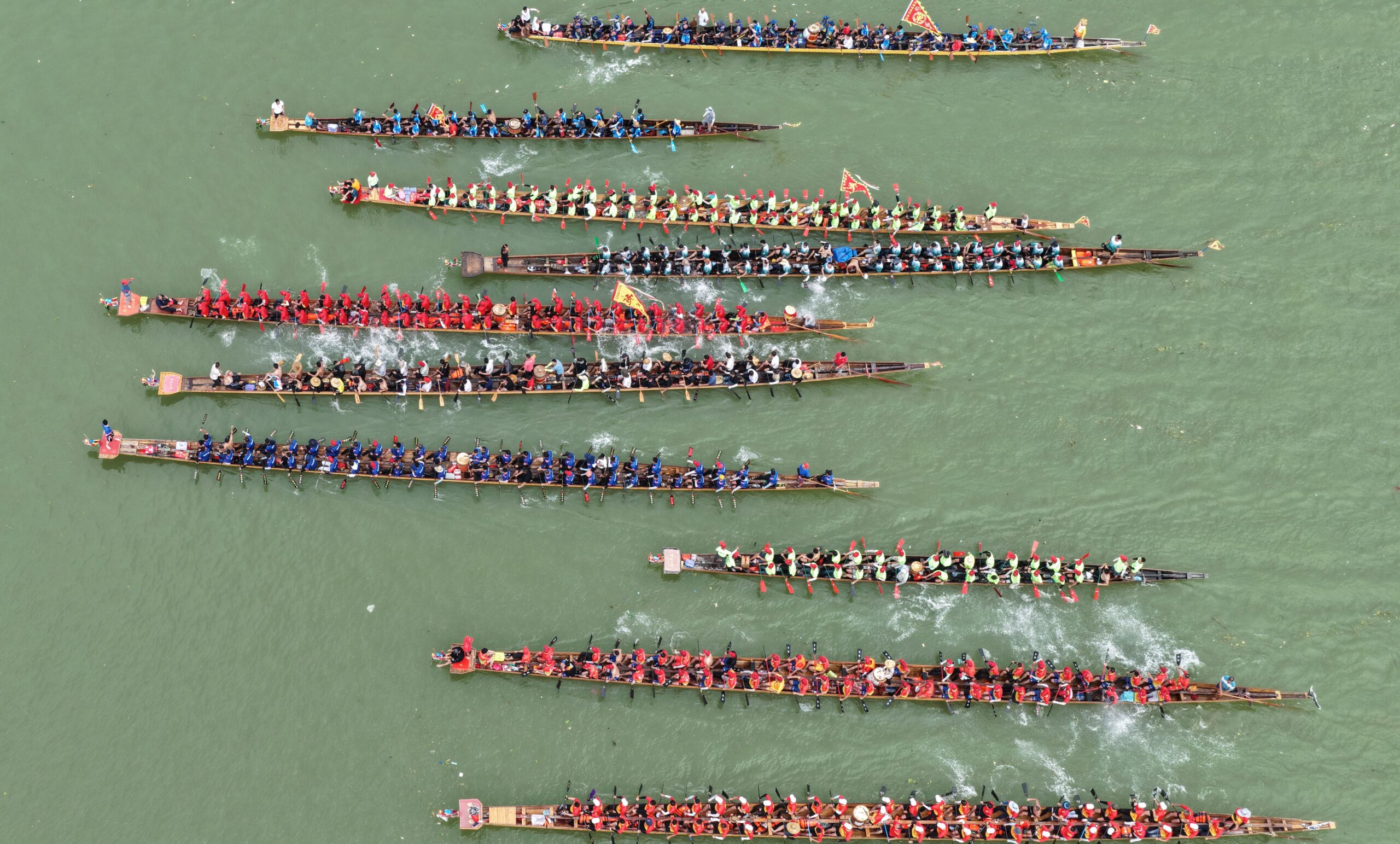
As race morning dawns, we lean over the balustrade, giddy with anticipation, aware that we’re about to witness something magnificent. Soon, the mighty Chundan Vallams appear on Punnamada Lake, their soaring sterns rising above the water like the hood of a cobra. Despite measuring well over a hundred feet in length, they move with a grace that defies their immense size. Beneath shifting monsoon clouds, shafts of sunlight catch the bronze finials adorning the prow and stern, while colourful pennants and silk parasols flutter above the crews, adding colour against the slate-grey sky.
While we wait for the boats to line up, fellow spectators explain that each boat carries nearly a hundred rowers. Standing above them, the chief helmsmen direct every movement like maestros conducting an orchestra. Beside them, singers and rhythm keepers lead the
vanchipattu— traditional boat songs that set the pace for every stroke and transform individual rowers into a perfectly coordinated team.
Then, in an instant, the race explodes to life. Arms rise and fall in perfect harmony as oars carve smooth arcs before plunging back into the frothing water. At 100 to 120 strokes a minute— nearly two every second— the crews move with stunning precision. Each movement follows the cadence of the vanchipattu. Muscles gleam, spirits blaze and the Chundan Vallams surge almost neck and neck across the shimmering lake. Along the banks, thousands roar their encouragement, willing their village heroes towards the finish.
This is the Nehru Trophy Boat Race I’ve travelled to witness. As we celebrate Independence Day this August, it’s moments like these that remind me exactly why we call it Incredible India. The crown jewel of Kerala’s Vallam Kali (boat racing) season, this vibrant race has even earned the nickname the “Backwater Grand Prix”, reflecting the speed and precision that define the event.
As the 19 competing Chundan Vallams thunder across the 1.5-kilometre course, an entire village’s hopes, months of predawn training and generations of tradition are compressed into just four minutes— 240 electrifying seconds. In this edition of the race, the Veeyapuram Chundan, rowed by the Pallathuruthy Boat Club, claimed victory, marking the club’s fourth consecutive win. The crowd erupts. Drums beat, flags wave and complete strangers celebrate together as though, in that moment, they too belong to the same village.
Not long after the winners have lifted the trophy, dusk begins to settle over Punnamada Lake, and the crowds begin to disperse. what stays with me is the extraordinary collaboration that makes it all possible. Every race represents months of shared effort— boat builders, carpenters, blacksmiths, singers, rowers, volunteers, priests, patrons and entire villages working towards a common goal. More than a sporting event or static showcase of history, the Nehru Trophy Boat Race is a living inheritance that continues to evolve while remaining deeply rooted in the communities that sustain it.
By the following morning, the backwaters are calm again. The boats are back in their boathouses, repairs are already being planned and another cycle has already begun. As the monsoon returns, the boats will return too, carrying perhaps a new generation of rowers,
another year of preparation and another village’s hopes on to Punnamada Lake. In Alleppey, glory is measured in four exhilarating minutes. Everything else is measured in years.
This piece has been published in the August 2026 issue of Namaste.ai – Air India’s inflight magazine